
St Monica's Catholic Primary School
Computing
Our Vision for Computing here in St Monica's
Children need a curriculum that is research-based and supports the pedagogy of how children learn. Our Computing curriculum aims to develop children’s computational knowledge and digital understanding in a meaningful way. Not only will it develop their understanding of computer science, information technology, and digital literacy, we want them to develop the skills to think and work like computer scientists.
A strong and continuous thread of online and computer safety runs throughout our curriculum, ensuring children learn to use technology responsibly, respectfully, and safely. We want children to experience a diverse Computing curriculum that allows them to make meaningful links, solve problems, and apply their learning in real-world contexts.
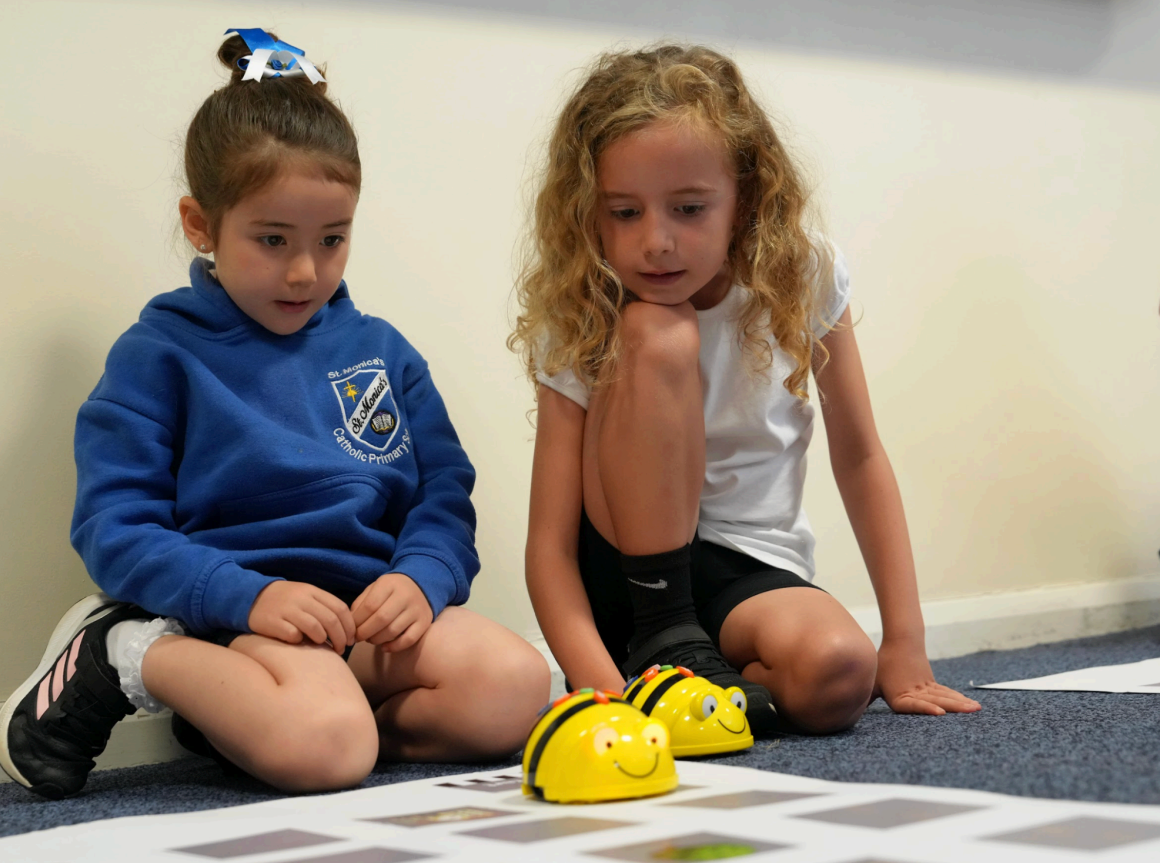
Curious Minds: Our pupils will begin by developing foundational digital skills before building a deeper understanding of algorithms, programming, and data. They will explore computing concepts with a curious mind, learning to decompose problems, create and debug programs, and use technology purposefully. Alongside this, pupils will develop an understanding of safe online behaviours, learning how to protect personal information, recognise potential risks, and seek help when needed. Pupils will have opportunities to make their own links and develop key skills such as logical reasoning, creativity, and perseverance.
Diversity is our Superpower: We learn about Computing through a diverse lens and understand how technology has been developed and used by people from different backgrounds across the world. Pupils will learn about a range of innovators in Computing and explore how digital technologies impact society. Through this, children will develop an understanding of digital citizenship, including respect, inclusion, and responsible communication online. They will learn how technology can both positively and negatively affect people’s lives and how to use it in ways that are ethical and safe.
Lifelong Learners: We want our children to be confident, motivated, and enthusiastic when learning in Computing lessons. We aim to teach Computing in a way where key knowledge and skills are valued, remembered, and assessed. Computer safety is revisited and reinforced at every stage, ensuring pupils develop age-appropriate understanding of online safety, privacy, and digital wellbeing. Pupils will evaluate digital content, reflect on their own work, and apply their learning across the curriculum, building secure computing knowledge and safe digital habits throughout their time at St Monica’s.
Intent
A high-quality computing education equips pupils to use computational thinking and creativity to understand and change the world. Computing has deep links with mathematics, science, and design and technology, and provides insights into both natural and artificial systems. The core of computing is computer science, in which pupils are taught the principles of information and computation, how digital systems work, and how to put this knowledge to use through programming. Building on this knowledge and understanding, pupils are prepared to use information technology to create programs, systems and a range of content. Computing also ensures that pupils become digitally literate – acquire and demonstrate the knowledge and skills – to express themselves and develop their ideas through, information and communication technology – at a level suitable for the future workplace and as active participants in a digital world. We believe digital literacy is an essential element of computing, enabling our pupils to stay safe online and access all areas of the computing curriculum.
We aim to teach computing effectively through providing a rich, broad and balanced computing curriculum fully mapped to the National Curriculum for Computing (DfE, 2013) across our school. Our curriculum offers pupils a computing education designed for mastery and covers all three strands of the computing curriculum:
- Computer Science
- Information Technology
- Digital Literacy (incl. Online Safety)
We believe mastery in computing means acquiring a deep, long-term, secure and adaptable understanding of the subject. This is demonstrated by how skilfully children can apply their learning to new situations in unfamiliar contexts.
Technology is everywhere and will play a pivotal part in students' lives, therefore our computing curriculum is designed to provide children with the skills and knowledge they need to use technology safely and creatively. Computing is not just about memorising facts and vocabulary, it is about solving complex problems, being able to collaborate with others and learn from mistakes.
Our aim is for our children to independently enjoy using technology while developing 21st-century skills. We want our pupils to understand that they have a choice when using technology.
As a school we utilise technology to model positive use and promote safe online communication and feedback. We recognise that technology can allow pupils to share their learning in creative ways. We also understand the accessibility opportunities technology can provide for our pupils.
Our knowledge rich curriculum has been balanced with opportunities for pupils to apply their knowledge creatively, which will in turn help them to become skilful computer scientists.
We encourage staff to try and embed computing and technology across the curriculum to make learning creative and accessible through using technology in a considered manner to further support pupils’ learning in line with latest research from the Education Endowment Foundation (EEF) (Using Digital Technology to Improve Learning, March 2019).
We want our pupils to be fluent with a range of tools to best express their understanding. This will allow greater independence and confidence when choosing the best tool to fulfil the task and challenge set by teachers.
Digital Safety in St Monica's
We interweave Digital Safety into our Computing Curriculum. We use Childnet's highly regarded resources to build and recap on knowledge throughout a pupil's time with us.
We have included this on our Long Term Plan, as we believe that preparing our pupils for a safe future using digital devices is key for them to flourish in the online world.
Who are Childnet?
Childnet work directly with children and young people from the ages of 3-18, as well as parents, carers, teachers and professionals, finding out about their real experiences online and the positive things they are doing.
Childnet equip pupils to stay safe online and create and update resources relevant to the here and now.
At the heart of all of their work is the belief that when used properly, the internet and digital devices are wonderfully positive tools for children and young people.
They strive to take a balanced approach, making sure that they promote the positive opportunities of the digital world, as well as responding to the risks and equipping children with a toolbox on how to deal with them.
Implementation
Our curriculum is carefully mapped out to ensure that pupils acquire knowledge, vocabulary and skills in a well-thought out and progressive manner. Each cohort follows a combination of Teach Computing units and Computer Science lessons structured using the Code Studio planning and progression documents.
The combination of Teach Computing and Code Studio schemes highlight the knowledge, skills and vocabulary for each year group and are progressive from year to year. Themes are revisited regularly (at least once in each year group), and pupils revisit each theme through new units of work that consolidate and build on prior learning within that theme.
We teach computing both discretely and apply learned skills in cross curricular contexts when clear links with other subjects are present.
Our Computing units and progression model is broken down into four strands that make up our computing curriculum. These are: Functional Skills, Computer Science, Information Technology and Digital Literacy.
- Functional Skills: ensure the children have the core basic skills to use multiple devices, this is designed to promote independence.
- Computer Science: underlines the knowledge and skills relating to computational thinking, coding, algorithms and networks.
- Information Technology: underlines the knowledge and skills relating to digital communication, creating multimedia content and data representation/handling.
- Digital Literacy: underlines the knowledge and skills relating to online safety and technology in society.
Pupils are taught through whole-class interactive teaching with pupils working together on the same lesson content at the same time, providing clear instruction therefore laying the foundations for effective feedback throughout the lesson (EEF; Teacher Feedback to Improve Pupil Learning, June 2021). Lessons are sequenced so that concepts are developed in logical steps with particular attention given to fundamental concepts. We believe in a curriculum that meets the interests of all learners, with a range of exciting creative activities and open-ended challenges based on the essential requirements of the computing program of study.
Our children have access to a variety of resources that enable them to continue the learning of computing at home. For example; Seesaw and Times Tables Rock Stars. Through these the children are able to complete set tasks and save their work virtually so that it can be shared both in school and at home with teachers and parents. The role of parents is recognised and they are involved in understanding how to keep their children safe at home and have access to
Computer Science units reflect a number of teaching strategies including the ‘predict, run, investigate, modify, make’ (PRIMM) model to support children to develop their knowledge and skills in computer programming effectively. The units also make use of the TIPP and SEE structured scaffolding strategy, and Parsons Problems which require learners to place given lines of code into the correct order to form a working code segment. Code Studio courses are designed so that the teacher also acts as the lead learner. They will begin by exposing the Computer Science concept to students as an abstract concept, unpacking it by linking it to everyday experience, then putting it into a different context, and using simpler, more concrete examples. The video resources can often be used to support this. Teachers will then repack the knowledge back into the abstract form. This could be in the form of an algorithm which will then be turned into code for the computer to execute.
Impact
The biggest impact we want on our children is that they understand the potential and capabilities of technology and that they are also aware of how to maintain a safe and healthy digital life. We measure the impact of our curriculum through the following methods:
- Pupil discussions, asking the pupils about their learning (pupil voice).
- Assessment/feedback on content creation.
- Moderation staff meetings with opportunities for dialogue between teachers.
- Photo evidence of the pupils’ practical learning.
- Pupil self-reflection.
- A reflection on standards achieved against the planned outcomes (progression/what to observe in learning).
- Learning walks and reflective staff feedback (teacher voice).
- Dedicated Computing leader time.
- Formative and summative approaches.
Through teaching and the integration of digital/verbal feedback and peer evaluation, we strive to model and educate our pupils to use technology positively, responsibly and safely. Discussions between staff and pupils help the children to understand their progress and their next steps.
Regular monitoring identifies children who may be struggling to meet their learning outcomes, additional support is given to support future progress. If children are keeping up with the curriculum, they are deemed to be making good or better progress.