St Monica's Catholic Primary School
Science

Science Vision: We Are Scientists!
At St Monica’s, our Science curriculum provides children with inspiring, creative and meaningful learning experiences that build on their natural curiosity about the world around us, and ignites their passion for learning in this fascinating subject.
We want to instil three core values in our Science curriculum: we want to develop curiosity in the world around them; give our pupils a diverse understanding of how different cultures and communities have contributed to scientific understanding. Finally, we want all pupils to become 'Lifelong Learners', remember key facts and have scientific skills that help them engage and succeed in Science, both here and in the future.
Curious Minds: Starting in Nursery, our pupils will learn about the world they live in through first-hand experiences and enquiry before developing a deeper understanding of scientific concepts over time. They will explore scientific questions with a curious mind, investigate evidence, use scientific vocabulary accurately, and have opportunities to make their own links while developing key skills such as observing, predicting, testing, recording, and concluding.
A Diverse Lens: We learn about Science through a diverse lens and understand how scientific knowledge has developed over time across different cultures and communities. Pupils will learn about a wide range of scientists and scientific discoveries, and understand how scientific advances have impacted people’s lives in the past and continue to shape the world today.
Lifelong Learners: We want our children to be passionate, engaged, and motivated when learning in Science lessons. We aim to teach Science in a way where key knowledge is valued, remembered, and assessed. Pupils will evaluate evidence, carry out investigations, and discuss scientific ideas, building secure scientific knowledge and skills throughout their time at St Monica’s.
Children need a curriculum that is research-based and supports the pedagogy of how children learn. Our Science curriculum aims to develop children’s scientific knowledge in a meaningful way. Not only will it develop their understanding of biology, chemistry, and physics, we want them to develop the skills to work like a scientist.
Our Science Curriculum
'To promote curiosity about the world and how it works, through child-centred activities.'
At St Monica’s Catholic Primary School, we believe a high-quality science education provides the foundations for understanding the world. We have a highly sequenced curriculum, with clear links and progression from Nursery, right up to Year 6.
Nursery and Reception
In EYFS, Science is experienced through the Understanding the World area of learning, where children are encouraged to explore, observe, question and make sense of the world around them through first-hand experiences. Learning is play-based and highly practical, with a strong emphasis on curiosity, talk and exploration. Children develop early scientific skills as they investigate natural materials, observe living things, explore changes over time and use simple language to describe what they notice. Carefully planned continuous provision and adult-led interactions support children to ask questions, make predictions and begin to recognise patterns, laying secure foundations for scientific thinking as they move into Key Stage 1.
Year 1 to 6
Between Year 1 and Year 6, we teach Science using the CUSP curriculum, which pays close attention to guidance provided by the National Curriculum sequence and content. This ambitious Science curriculum has the intention of increasing children’s ability to think scientifically, enriching children’s vocabulary and wider view of the world, and putting what they learn into practice.
The methodology for teaching Science at St Monica's is to provide opportunities for children to develop their questioning skills, ignite curiosity and to widen their knowledge of the world and how it works. We want our children to respond proactively and positively to problem-solving challenges and strive to learn more about the “how” and “why” of the world around us and beyond. We recognise that ‘our children are the future’ and they need to be equipped with the necessary skills to take risks, become resourceful, innovative, and questioning in order to become capable citizens.
Cross Curricular
We also recognise that Science encompasses a broad range of subject knowledge and draws on disciplines from the wider world, such as mathematics, engineering, computing and geography. We believe making these curriculum connections is an essential component in our school that helps to engage and connect our children with the amazing array of opportunities that Science provides.
Disciplinary and Substantive Knowledge in our lessons:
Substantive knowledge– this is the subject knowledge and explicit vocabulary used to learn about the content. Common misconceptions are explicitly revealed as non-examples and positioned against known and accurate content. In CUSP science, an extensive and connected knowledge base is constructed so that pupils can use these foundations and integrate it with what they already know. Misconceptions are challenged carefully and in the context of the substantive and disciplinary knowledge. In CUSP Science, it is recommended that misconceptions are not introduced too early, as pupils need to construct a mental model in which to position that new knowledge.
Disciplinary knowledge – this is knowing how to collect, use, interpret, understand and evaluate the evidence from scientific processes. This is taught. It is not assumed that pupils will acquire these skills by luck or hope. Pupils construct understanding by applying substantive knowledge to questioning and planning, observing, performing a range of tests, accurately measuring, comparing through identifying and classifying, using observations and gathering data to help answer questions, explaining and reporting, predicting, concluding, improving, and seeking patterns. We call this knowledge ‘Working Scientifically.’
What is the CUSP curriculum and how does it inspire our Intent, Implementation and Impact in Science?
Intent
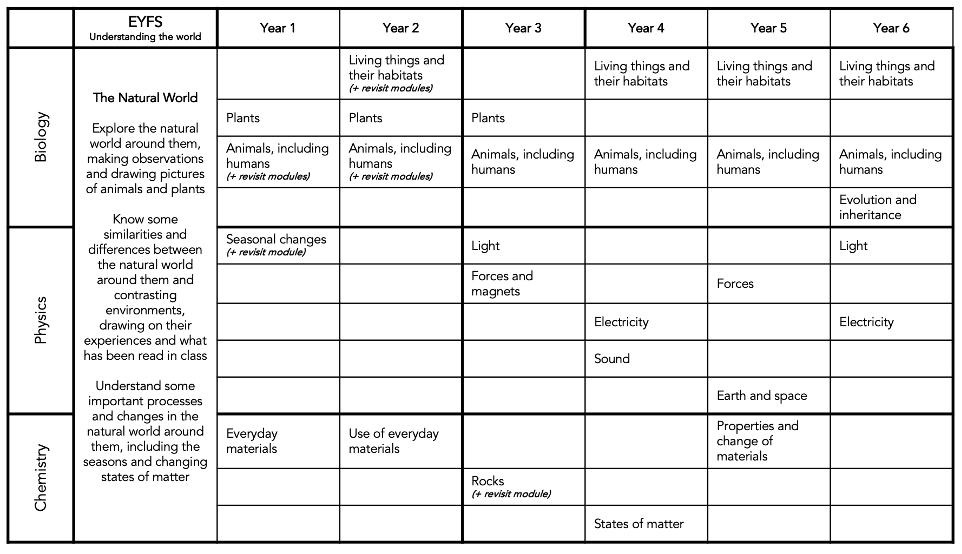
A guiding principle of CUSP Science is that each study draws upon prior learning. For example, in Nursery and Reception, pupils learn about The Natural World through daily activities and exploring their locality and immediate environment. This is revisited and positioned so that new and potentially abstract content in Year 1, such as "Animals, including Humans", is related to what children already know. This makes it easier to cognitively process. This helps to accelerate new learning as children integrate prior understanding.
CUSP Science is organised into three distinct subject domains: biology, physics and chemistry.
Implementation
CUSP Science has sequenced the national curriculum into meaningful and connected ‘chunks’ of content to reduce the load on the working memory as well as creating coherent and strong long-term memories. The sequence of substantive and disciplinary knowledge enables pupils to become ‘more expert’ with each study and grow an ever broadening and coherent mental model of the subject. This guards against superficial, disconnected and fragmented scientific knowledge and weak disciplinary knowledge. Each learning module in CUSP Science has a vocabulary module with teacher guidance, tasks and resources to enhance and deepen understanding.
CUSP Science is planned so that the retention of knowledge is much more than just ‘in the moment knowledge’. The cumulative nature of the curriculum is made memorable by the implementation of retrieval and spaced retrieval practice, word building and deliberate practice tasks. This powerful interrelationship between structure and research-led practice is designed to increase substantive knowledge and accelerate learning within and between study modules.
New content is connected to prior learning. The effect of this cumulative model supports opportunities for children to associate and connect significant scientific concepts, over time, and with increasing expertise and knowledge.
CUSP Science deliberately pays attention and values the importance of subject content as well as the context it is taught in. Common scientific misconceptions are identified in all CUSP Science learning modules. These misconceptions are made explicit to pupils. Children draw upon substantive and disciplinary knowledge to reason and practise acquiring the conception, whilst repelling the misconceptions.
CUSP Science values the study of scientists from the past as well as promoting diverse present-day role models in the field. These studies help us to learn how they used, at that time, their substantive and disciplinary knowledge to develop a conception.
Impact
CUSP fulfils and goes well beyond the expectations of the National Curriculum. By following this curriculum, we hope children will know more, remember more, understand more about the curriculum. Impact is measured by end of unit tests, which are recorded to understand the pupils' strengths and weaknesses - and the knowledge we need to return to these to ensure our pupils have strong foundations.
All children will have:
- A wider variety of skills linked to both substantive and disciplinary knowledge
- A richer vocabulary which will enable them to articulate their understanding of taught concepts
- Confidence and a love of learning for all things science
Gallery